
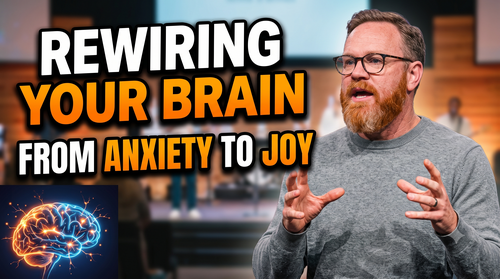
Changing the Fuses of Your Brain
A 5-Day Devotional on the Power of Gratitude
Day 1: Why Does God Want Our Praise?
Scripture Reading: "If I were hungry I would not tell you, for the world and its fullness are mine." - Psalm 50:12
Have you ever read the Psalms and thought, "What is the deal with God's ego? Why does He constantly want me to praise and thank Him?" C.S. Lewis struggled with this very thought early in his Christian walk. It felt as though God was a vain deity demanding applause.
But here is the beautiful truth: God does not need anything. Before the universe was created, the Father, Son, and Holy Spirit existed in perfect, self-sustaining love. God didn't create the universe because He was lonely or needy; He created it as an overflow of love. When God commands us to give thanks, He isn't saying, "Feed my ego." He is giving us a command for our benefit.
We are the ones who need to give thanks. Praising God reminds us of who He is and who we are. It aligns our hearts with reality. God's commands are always for our ultimate good, and gratitude is the key that unlocks our joy.
Reflection: How does it change your perspective to know that God's command to praise Him is actually a tool for your own healing and joy?
Prayer: Lord, forgive me for the times I have viewed Your commands as a burden. Thank You for loving me enough to invite me into the joy of praising You. Help me see that gratitude is Your gift to my soul. Amen.
Day 2: Rewiring Your Brain
Scripture Reading: "I will sing to the Lord, for he has dealt bountifully with me." - Psalm 13:6
Science is finally catching up to the Bible. From a neurological point of view, the simple activity of giving thanks is deeply healing. When we practice gratitude, it removes cortisol (the chemical responsible for fear, worry, and the "fight or flight" response) from our bodies. At the same time, it produces dopamine and serotonin-our brain's natural pleasure and well-being chemicals.
When you thank God, you are literally sucking worry out of your flesh. But it goes even deeper: the purposeful activity of giving thanks rewires the neural pathways in your brain. It changes your brain's "fuses" from a worry circuit to a rejoicing circuit, making you less capable of anxiety and more capable of joy.
In Psalm 13, David begins by crying out in despair, asking if God has forgotten him. But by the end of the Psalm, he is singing praises. His difficult circumstances hadn't changed, but his perspective had. Gratitude shifted his brain and his heart.
Reflection: What is one heavy burden or worry you are carrying right now? Pause, take a deep breath (a gift you didn't earn!), and find one thing to thank God for in the midst of it.
Prayer: Father, praise You for creating my brain and my body. Thank You that as I lift my voice in gratitude, You are healing my mind and driving out anxiety. Teach me to default to thanksgiving. Amen.
Day 3: The "All" in All Circumstances
Scripture Reading: "Give thanks in all circumstances; for this is the will of God in Christ Jesus for you." - 1 Thessalonians 5:18
How many circumstances are outside the category of "all"? None. Yet, this is one of the hardest commands in Scripture to follow. We often face situations where we cry out, "Lord, I'm supposed to thank You for this?"
God isn't asking us to thank Him for tragedy, abuse, or evil. But He is asking us to find reasons for gratitude within the darkness. We can thank Him that He is with us. We can thank Him that He won't let us walk through the valley alone. We can thank Him for the eternal hope we have on the other side.
The Greek word for giving thanks here is eucharisteo, which combines the words for "goodness" and "grace." To give thanks is to intentionally set our attention on the goodness of God's grace in any given moment. It is opening our eyes to see the activity of God that is right in front of us.
Reflection: What is a difficult circumstance you are facing right now? Write down three specific ways God's goodness or grace is still present in the middle of it.
Prayer: Lord, giving thanks in the hard times is a sacrifice. But I trust that Your grace is good. Thank You for being my anchor in the storm. Open my eyes to see Your blessings today. Amen.
Day 4: Gratitude as a Shield
Scripture Reading: "For although they knew God, they did not honor him as God or give thanks to him, but they became futile in their thinking, and their foolish hearts were darkened." - Romans 1:21
There is a profound danger in an ungrateful mind. When we forget that everything we have is a gift from a loving Creator, we begin to rely solely on our own strength. We think wrongly about ourselves, wrongly about the world, and most dangerously, wrongly about God.
A lack of gratitude turns us into entitled children. We start pointing fingers at God, focusing on what we don't have, and resentment begins to destroy us from the inside out. But gratitude acts as an impenetrable shield. A heart filled with gratitude cannot be easily deceived by the enemy.
When Satan whispers lies that God is holding out on you, a grateful heart simply bounces those lies away. You can stand firm and say, "God has given me everything, including the breath in my lungs. Why would I doubt His goodness now?"
Reflection: Are there areas of entitlement or resentment creeping into your heart? Confess them to God and actively replace those thoughts with statements of thanksgiving.
Prayer: God, guard my heart against entitlement and resentment. Remind me daily that every good thing I have is a gift from Your hand. Let gratitude be my shield against the lies of the enemy. Amen.
Day 5: The Practice of Thanksgiving
Scripture Reading: "Do not be anxious about anything, but in every situation, by prayer and petition, with thanksgiving, present your requests to God." - Philippians 4:6
We all want to live without anxiety, but it's not something we can do in our own strength. Paul tells us that the very first step in combating anxiety is bringing our prayers to God with thanksgiving. Gratitude is the prerequisite to peace.
This requires practice. In a recent scientific study, participants spent just 20 minutes a day for three weeks writing thank-you notes. Months after the study ended, brain scans showed these individuals were still significantly less anxious and more capable of accessing joy. A short, intentional practice of gratitude physically and permanently altered their well-being.
What if we dedicated ourselves to the practice of thanksgiving? It could be picturing the face of a loved one and thanking God for their features and personality. It could be writing a thank-you letter. It could be listing God's faithfulness to your parents, your grandparents, and yourself. He is faithful. Trust Him.
Reflection/Action: Take a challenge today. Spend the next 10-15 minutes writing a thank-you note-either to a person who has blessed you or directly to God. Start building a daily habit of intentional gratitude.
Prayer: Lord, I want to partner with You in living a life of deep gratitude. Thank You for my family, my friends, and the countless ways You have provided for me. Help me to make thanksgiving a daily habit, trusting in Your faithful love. Amen.